


Picture Analogies
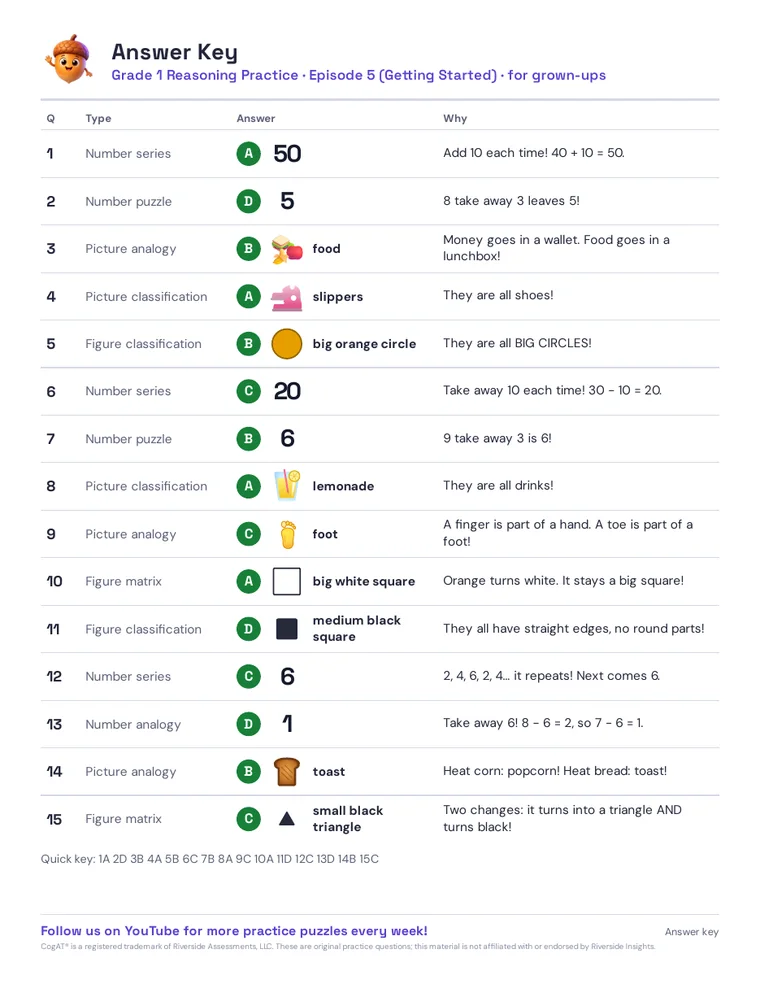
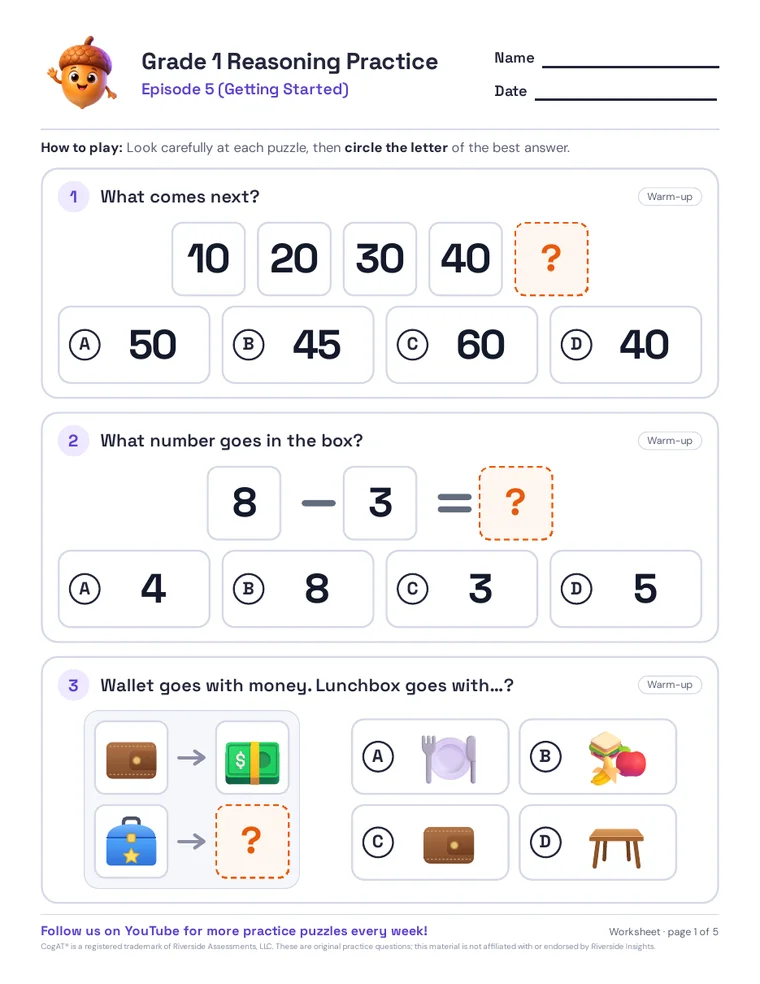
A bird goes with a nest. A bee goes with…? Kids find how two pictures are related and use the same rule.
Short, cheerful videos with CogAT®-style reasoning questions your child can play along with: pictures, numbers and shapes, every question read aloud. We’re starting with Grade 1, with Kindergarten and Grade 2 on the way.
Free printable sampler
Ten original picture puzzles to print and solve together, with answers and a short guide for grown-ups. Enter your email and we’ll send you the PDF.
What kids practice
Gifted and talented screeners like the CogAT® look at how children reason with words, numbers and shapes. Our episodes and printables practice the same nine kinds of questions, grouped the same way.
Words and ideas, shown with pictures
A bird goes with a nest. A bee goes with…? Kids find how two pictures are related and use the same rule.
A short question is read aloud, and kids pick the picture that answers it.
Three pictures belong together. Which one belongs with them? Kids name what the group has in common.
Numbers, amounts and patterns
Spot the change from one amount to the next (like “2 more”), then do the same thing again.
Find the missing amount that makes both sides the same.
What comes next? Kids find the counting pattern and keep it going.
Shapes, space and visual patterns
Shapes change across a grid. Kids work out the change and pick the shape that completes it.
Fold the paper, punch a hole, open it up. Where do the holes end up?
Three shapes are alike in some way. Kids find the rule and choose the shape that fits.
At the K–2 levels, test questions are mostly pictures and the teacher reads the directions aloud, so children don’t need to read. Our videos work the same way: every question is spoken by Acorn, our host.
Watch together
Each episode is about 6 minutes: 15 original questions, a friendly countdown, and a clear answer with the reason. Pause any time your child wants more thinking time.
Printables
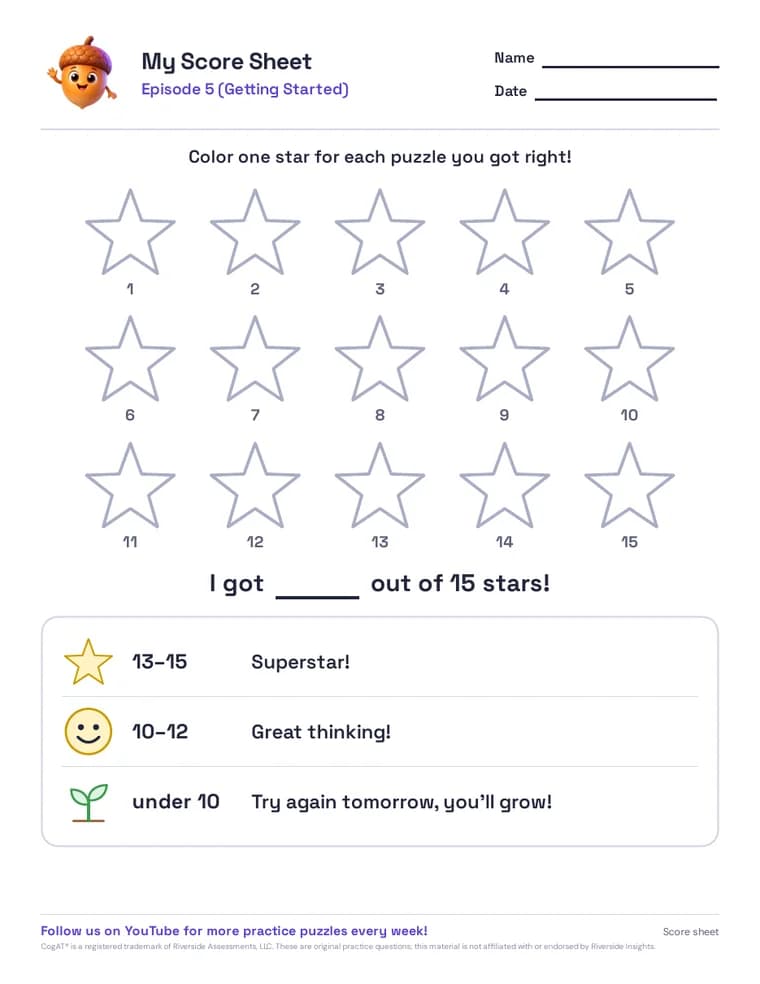
Coming soonPrint-and-solve worksheets that match the episodes, with answer keys, score sheets and notes for grown-ups. The packs are almost ready. Join the list to hear first, and get the free Grade 1 pack now.
10 questions, answer key, score sheet, coaching page and a 4-week checklist.
Get it freeOne pack per unit (Getting Started, Patterns, Relationships…).
Every unit in one download, from first puzzles to test-ready practice.
Be the first to know when the packs are ready.
Join the listFor parents
Short, relaxed practice works best. Here’s a simple routine that fits around school, homework and play.
Sit with your child for one episode, or print one worksheet page.
Let your child point to A, B, C or D before the answer shows. Pause whenever they need more time.
Explaining why builds more reasoning than getting the answer right.
Count the stars, praise the effort, and come back tomorrow.
The Cognitive Abilities Test (CogAT®) is a reasoning test from Riverside Insights. Many U.S. school districts use it, sometimes as a shorter screener, to help find students for gifted and talented programs.
The full test has 9 short subtests grouped into 3 batteries: Verbal, Quantitative and Nonverbal. It looks at how children reason with words, numbers and shapes, not at what they’ve memorized in class. Each district decides how it uses the results.
First graders usually take Level 7. Your district chooses the level, the form, and whether to give the full test or a shorter screener, so check with your school.
At the K–2 levels the publisher describes the subtests as untimed: the teacher reads each question aloud and sets the pace for the group, and each battery is usually given in its own session. Ask your school how testing days are planned.
Our videos use a short, friendly countdown just to keep things moving. Pause whenever your child needs more time.
No. Every Gifted Acorns question is original: we write and check each one to practice the same kinds of thinking. We never use or copy real test items or the publisher’s sample questions.
Practice can make the format feel familiar and build confidence, but no practice material can promise a score or a place in a program.
No. Gifted Acorns is independent. CogAT® is a registered trademark of Riverside Assessments, LLC (Riverside Insights), and we use the name only to describe the kind of test our practice is designed for.
Watch together, on a big screen if you can. Acorn reads each question aloud. Your child points to or says A, B, C or D, then you watch the answer and the reason together. Pause whenever they need more time, and rewatch an episode a few days later. One episode a day is plenty.
It depends on your district. Many schools test in the fall or in winter (January–February). Check your district’s gifted program page or ask your child’s teacher for dates.